SP 500 Trading: Market Trends and Insights
The SP 500 trading market has become one of the most followed and active financial environments globally, drawing attention from traders, investors, and economists alike. Representing the performance of 500 leading publicly traded U.S. companies, the S&P 500 Index serves as a vital indicator of the overall health of the American economy and a benchmark for international markets. As global financial conditions evolve, understanding how to trade, analyze, and interpret this index becomes essential for both seasoned investors and newcomers to the financial world.
At its core, SP 500 trading provides traders with exposure to the U.S. stock market through derivatives, CFDs, ETFs, and futures contracts. Whether trading short-term market swings or building a long-term investment strategy, mastering the movements of this index is key to achieving consistent profitability. Platforms like Afaq are revolutionizing how investors engage with indices such as the S&P 500 — offering advanced trading tools, educational resources, and real-time analytics to empower traders in making smarter and more strategic decisions.
Overview of the S&P 500 Index
The S&P 500 is not just a number — it’s a reflection of the heartbeat of the U.S. economy. Introduced in 1957 by Standard & Poor’s, this index tracks the stock performance of 500 of the largest companies listed on U.S. stock exchanges. It’s considered a comprehensive measure of how the economy and the corporate sector are performing. The SP 500 trading community uses it as a benchmark for evaluating portfolio performance, understanding market direction, and forecasting future trends.
Importance of SP 500 in Global Markets
The S&P 500 holds immense influence on global financial markets. Because it includes companies across all sectors — from technology and energy to healthcare and consumer goods — its performance serves as a barometer for investor confidence worldwide. When the S&P 500 rises, it often triggers optimism in international markets; when it falls, global investors tend to become more risk-averse.
International traders and investors often rely on SP 500 trading to diversify their portfolios and gain exposure to top-performing U.S. corporations. The index’s impact is so significant that major investment funds, hedge funds, and even government institutions track it closely. With Afaq, traders gain access to real-time data and market insights, enabling them to follow SP500 trading trends with precision and confidence.
Understanding the S&P 500 Index
The S&P 500 Index is a leading benchmark that reflects the overall strength of the U.S. stock market. It offers investors a broad view of how major companies are performing across various sectors.
Composition and Top Companies in the Index
The S&P 500 comprises a carefully selected group of companies from various industries. These include global giants such as:
- Apple Inc.
- Microsoft Corporation
- Amazon
- Alphabet (Google’s parent company)
- NVIDIA
- Johnson & Johnson
- ExxonMobil
- JPMorgan Chase
These companies represent the core of the SP 500 stocks list, which is periodically reviewed and updated by Standard & Poor’s. To qualify for inclusion, a company must meet criteria such as market capitalization, liquidity, and profitability.
The SP500 futures stock market is driven largely by these companies’ performances. Their quarterly earnings, innovations, and global reach contribute significantly to the index’s volatility — making SP 500 trading both exciting and lucrative for traders who understand market dynamics.
How is the S&P 500 Calculated?
The S&P 500 uses a market capitalization-weighted formula, meaning that larger companies have a greater influence on the index’s movements. The total market value of all 500 companies is divided by a proprietary divisor maintained by S&P Dow Jones Indices to produce the final index figure.
This calculation method ensures that changes in the largest companies, such as Apple or Microsoft, have a greater effect on the index than smaller ones. As a result, SP 500 trading often reacts strongly to major news or earnings from the top companies on the SP 500 stocks list.
Historical Performance and Market Influence
Historically, the S&P 500 has delivered consistent long-term growth, reflecting the resilience and expansion of the U.S. economy. Despite short-term corrections and recessions, the index has shown remarkable recovery power over decades. This reliability makes SP 500 trading a preferred choice among investors seeking exposure to large-cap equities.
The S&P 500 also serves as a benchmark for mutual funds, ETFs, and institutional investors. Understanding its historical performance allows traders to anticipate market cycles, identify buying opportunities, and develop strategies that align with broader economic trends — all essential for success in SP500 trading.
How to Trade the SP 500?
Engaging in SP 500 trading can be done through multiple instruments and methods. Traders can use trading S&P 500 futures, CFDs, ETFs, or index funds. Each method offers different benefits depending on trading goals, risk tolerance, and capital.
- Trading S&P 500 Futures – These are contracts that allow traders to speculate on the future value of the index. Professionals widely use them to hedge portfolios or capitalize on market trends.
- CFDs (Contracts for Difference) – A flexible way to trade the S&P 500 without owning any underlying assets. With Afaq, traders can go long or short based on their market outlook.
- ETFs (Exchange-Traded Funds) – For long-term investors, ETFs like SPY replicate the performance of the S&P 500 and provide diversified exposure to all 500 companies.
Platforms like Afaq give traders access to global markets, competitive spreads, and advanced analytics that make SP 500 trading efficient, transparent, and accessible. With tools like technical charts, risk calculators, and educational materials, Afaq empowers traders to make data-driven decisions.
SP 500 Trading Strategies
SP 500 trading strategies help investors navigate market movements with confidence. They provide structured approaches to identifying opportunities and managing market trends effectively:
Short-term vs. Long-term Trading
There are two primary approaches to SP 500 trading — short-term and long-term. Short-term traders (scalpers and day traders) take advantage of daily volatility, while long-term investors rely on compounding growth and index stability.
Short-term SP500 trading requires fast decision-making, deep analysis, and tight risk management. Long-term traders, on the other hand, benefit from lower stress and reduced transaction costs while focusing on macroeconomic trends and fundamental company data.
Technical and Fundamental Analysis Techniques
Effective SP 500 trading combines both technical and fundamental analysis:
- Technical Analysis: Involves studying price charts, volume indicators, and trend patterns. Online trading tools like Moving Averages, RSI, and MACD are commonly used to identify market entry and exit points.
- Fundamental Analysis: Focuses on the financial performance of companies within the SP 500 stocks list, macroeconomic indicators, and interest rate trends.
Using Afaq’s advanced charting platform, traders can analyze both technical and fundamental elements simultaneously, building comprehensive strategies for SP500 trading.
Common Indicators Used for S&P 500 Trading
Some popular indicators for SP 500 trading include:
- Relative Strength Index (RSI) – Measures market momentum.
- Moving Averages (MA) – Helps identify long-term trends.
- Bollinger Bands – Detect volatility and price breakouts.
- Fibonacci Retracements – Assist in finding support and resistance levels.
Combining these tools with Afaq’s analytics allows traders to improve their decision-making accuracy.
SP 500 Live Chart and Technical Analysis
The SP 500 live chart offers a real-time view of market movements, helping traders stay aligned with current trends. It supports clearer analysis and more informed trading decisions.
How to Read the SP 500 Live Chart?
A live chart displays real-time movements of the S&P 500 index, helping traders monitor price fluctuations and trading volume. Understanding chart patterns is essential for anyone involved in SP 500 trading.
Afaq offers real-time access to SP500 futures stock charts with customizable timeframes, allowing traders to visualize trends and analyze price behavior effectively.
Identifying Market Trends and Price Patterns
Recognizing price patterns such as double tops, head and shoulders, or trend channels helps traders anticipate reversals or continuations. Volume data also provides critical insights — when SP 500 trading volume rises sharply, it often signals institutional participation or impending breakouts.
By combining these insights with economic indicators, traders can use Afaq’s real-time charts to predict market behavior and refine their SP 500 trading strategies.
Economic Factors Affecting SP 500 Movements
Various economic factors play a significant role in shaping the SP 500 movements. Understanding these influences helps investors interpret market trends with greater clarity.
Role of Interest Rates, Inflation, and Earnings Reports
Economic conditions play a pivotal role in determining the SP 500 trading behavior.
- Interest Rates: When rates rise, stock valuations often decline, as borrowing becomes more expensive.
- Inflation: High inflation reduces purchasing power and corporate profits, negatively affecting the S&P 500.
- Earnings Reports: Positive earnings usually drive the index higher, while disappointing results cause declines
Understanding these elements is vital for timing entries and exits in SP500 trading. Afaq provides access to global economic calendars and live news updates that help traders react quickly to market-moving events.
Global Events and U.S. Economic Data Impact
Global developments — including geopolitical tensions, natural disasters, or technological shifts — can heavily influence the S&P 500. The U.S. also releases regular economic data (like GDP growth, unemployment, and CPI) that directly affect SP 500 trading volatility.
Traders who stay informed using Afaq’s resources can position themselves advantageously to capture profitable opportunities during these economic fluctuations.
Risk Management in SP 500 Trading
Effective risk management is essential for anyone trading the S&P 500. It helps investors protect their capital and make more disciplined trading decisions.
Managing Leverage and Position Sizes
Leverage allows traders to control larger positions with smaller capital — but it also amplifies risk. Proper position sizing ensures that no single trade threatens the trader’s capital.
Platforms like Afaq include integrated risk management tools that assist in calculating leverage ratios, position sizes, and margin requirements for safe SP 500 trading.
Setting Stop-Loss and Take-Profit Levels
Establishing stop-loss and take-profit orders is crucial in SP500 trading. These controls help limit potential losses and lock in profits automatically. Afaq’s trading platform allows users to set these parameters easily, providing better emotional control and trading discipline.
By combining analytical precision with structured risk management, traders can achieve consistent profitability and minimize exposure to market volatility.
Best Times to Trade the SP 500
The optimal times for SP 500 trading are during high-liquidity periods — typically between 9:30 AM and 4:00 PM EST when the U.S. markets are open. The first hour after market open and the last hour before closing are often the most volatile and provide the best opportunities.
Many traders using Afaq’s platform synchronize their activities with U.S. economic announcements to capture market reactions. Traders looking for overnight positions should consider trading S&P 500 futures, as futures markets operate almost 24 hours a day, allowing continuous exposure to price movements.
Services Of Afaq
AFAQ Trade is an electronic platform specializing in trading Contracts for Difference (CFDs), with a primary focus on the Gulf markets.
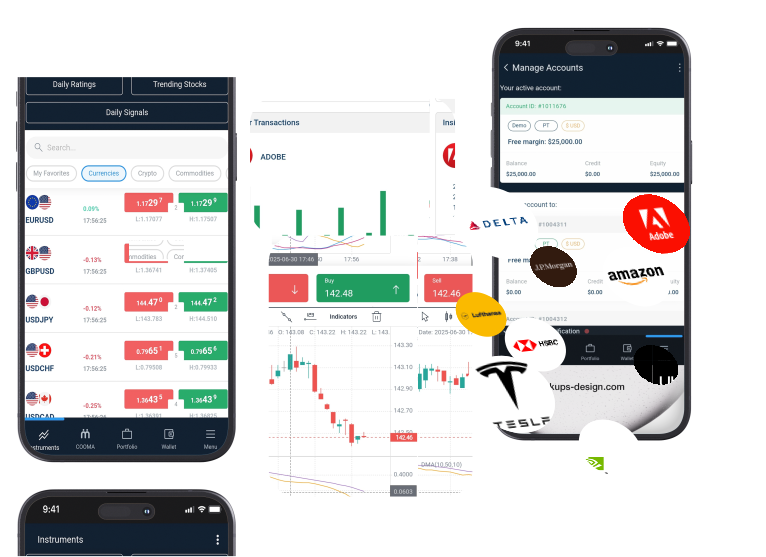
The platform aims to provide a simple, secure, and professional trading experience through platforms such as WebTrader and Mobile App, supported by educational tools like webinars, an academy, demo accounts, and a copy-trading feature.
Licenses and Legal Entity
The platform is owned by Afaq FX Markets (Comoros) LTD, registered in the Comoros.
It is licensed by the MWALI International Services Authority under license number BFX2025079, adding a layer of transparency and reliability for investors.
Key Services
- Trading in forex, stocks, commodities, and indices.
- Islamic accounts are compliant with Sharia.
- Demo account with $25,000 virtual funds for training.
- Advanced analysis tools, live customer support, and competitive trading fees (low spreads).
- Secure deposit and withdrawal procedures.
Account Types
- Basic – Minimum deposit up to $4,999.
- Advanced – From $5,000 to $19,999.
- Premium – $20,000 and above with advanced features.
- Sharia Account – Sharia-compliant, swap-free, with Sharia fees applied after the 4th day.
- Demo – Realistic trading experience with no financial risk.
In Conclusion
SP 500 trading is one of the most dynamic and influential forms of market participation available today. With the right knowledge, tools, and platform — like Afaq — traders can unlock the potential of this global benchmark to achieve financial growth and diversification.
Understanding the SP 500 stocks list, technical patterns, and global economic drivers empowers traders to make informed decisions. Whether through SP500 futures stock contracts or ETFs, consistent success in this market depends on discipline, education, and the right partner — and Afaq stands ready to guide traders every step of the way.
FAQs
How can I trade the S&P 500?
You can trade the S&P 500 using CFDs, futures, ETFs, or index funds. Afaq offers a seamless trading platform with real-time data and powerful analytics.
What if I invested $1000 a month in the S&P 500?
Historically, the S&P 500 has delivered around 8–10% annualized returns over the long term. Regular investments can compound significantly over time.
Can I invest $100 in the S&P 500?
Yes, through fractional shares or CFD trading on Afaq, you can begin SP 500 trading with a small investment.
How does SP 500 trading differ from Dow Jones or Nasdaq trading?
While the Dow Jones includes 30 companies and the Nasdaq focuses on tech-heavy stocks, the S&P 500 provides broader market exposure across all major sectors.