Dow Jones Trading: Market Trends and Insights
The Dow Jones Trading landscape has long been a central focus for both institutional and retail investors looking to gain exposure to the U.S. stock market. Representing the performance of some of the largest and most influential companies in the world, the Dow Jones Industrial Average (DJIA) serves as a barometer of economic health and investor sentiment. For traders, the Dow Jones offers not only insights into the state of the U.S. economy but also daily opportunities for speculation and profit.
What does the Dow Jones Industrial Average represent?
The Dow Jones Industrial Average is one of the most widely recognized indicators in the financial markets. It offers a quick snapshot of overall market sentiment and economic performance.
Why do traders follow the Dow Jones?
The Dow Jones Industrial Average represents a collection of 30 large, publicly traded companies that are considered leaders in their respective industries. These companies include household names such as Apple, Microsoft, Boeing, and Goldman Sachs. The index provides a broad view of the U.S. economy and is often used by traders and economists to measure the general direction of the stock market.
Traders follow the Dow Jones because it reflects investor confidence and economic trends. When the Dow Jones rises, it typically indicates optimism in the market, strong earnings, and stable economic conditions. Conversely, when the index declines, it often signals uncertainty, lower corporate profits, or potential economic slowdown.
For Dow Jones Trading, following the index closely helps investors anticipate price movements in related stocks and indices. Many traders also use Dow Jones Trading Economics reports and data from Afaq to analyze how global events — such as interest rate changes, inflation data, or geopolitical tensions — may influence market performance.
Additionally, the Dow Jones serves as a benchmark for various investment portfolios and funds. Understanding its dynamics is crucial for anyone looking to engage in Dow Jones Trading, whether through direct stock purchases, index funds, or derivatives such as CFDs (Contracts for Difference) and futures.
Understanding the Dow Jones Index
The Dow Jones Index is a key benchmark that investors watch to gauge the market’s overall direction. It provides a clear view of how major companies are performing within the broader economy.
Components of the Dow Jones
The Dow Jones Index is made up of 30 blue-chip companies chosen by the editors of The Wall Street Journal. These firms represent major sectors of the U.S. economy and are selected based on their reputation, size, and sustained growth. The list of components, often referred to as the Dow Jones Stocks List, changes occasionally to reflect shifts in the economy and emerging industries.
Some of the companies currently included in the Dow Jones are:
- Apple Inc.
- Microsoft Corporation
- The Coca-Cola Company
- Johnson & Johnson
- American Express
- Boeing
- Goldman Sachs
- McDonald’s
- Nike
Each of these companies influences the Dow Jones Trading environment differently, depending on its performance and weight in the index.
How is the index calculated?
Unlike many modern indices that are market-cap weighted, the Dow Jones is a price-weighted index. This means that stocks with higher share prices have a greater impact on the index’s overall movement, regardless of the company’s market capitalization.
The calculation involves summing up the stock prices of all 30 companies and dividing the total by a special divisor, known as the Dow Divisor. This divisor is regularly adjusted to account for stock splits, dividends, and other market actions that might distort the index’s value.
This unique calculation method is one reason Dow Jones Trading differs from trading indices like the S&P 500 or NASDAQ Composite. It also affects how Dow Jones Trading Volume and market reactions are interpreted by professional traders.
Factors influencing its movements
Several factors influence Dow Jones Trading:
- Earnings Reports: Quarterly corporate earnings often cause significant market reactions.
- Economic Data: Employment rates, consumer spending, and GDP growth influence investor sentiment.
- Monetary Policy: Decisions by the Federal Reserve on interest rates and liquidity impact the index heavily.
- Geopolitical Events: Global tensions, trade wars, or natural disasters can trigger volatility.
- Technological Trends: As tech companies form a large part of the Dow, innovation cycles and regulatory changes can drive price movements.
How to Trade the Dow Jones with Afaq?
Trading the Dow Jones with Afaq gives investors a straightforward way to engage with one of the world’s most influential market indices. It offers an accessible path to explore market movements and potential opportunities.
What does the Dow Jones Industrial Average represent?
Trading the Dow Jones through Afaq allows investors to gain exposure to the index’s movements using modern trading instruments. Whether through contracts for difference (CFDs) or futures, Afaq provides a secure, user-friendly, and data-rich platform to analyze and execute trades.
The index represents overall market confidence and serves as a powerful reflection of investor behavior. When traders analyze Dow Jones Trading Volume Charts, they gain insight into market momentum and liquidity levels — two critical elements for timing entries and exits effectively.
Why do traders follow the Dow Jones?
Investors follow the Dow Jones for both its historical significance and predictive power. Because it encapsulates the performance of 30 major companies, the Dow acts as a proxy for the health of the U.S. economy. Using Afaq’s analytics and Dow Jones Trading Economics data, traders can track macroeconomic indicators and correlate them with Dow Jones movements.
Afaq offers real-time data feeds, educational content, and advanced charting tools, making it easier for traders to develop and refine their Dow Jones Trading Strategy. By studying historical price patterns and trading volume charts, investors can identify entry points that align with market trends and risk tolerance.
How to Trade the Dow Jones?
Trading the Dow Jones allows investors to participate in the movements of a major global market index. It provides a simple way to follow economic trends and react to market changes.
Trading instruments: CFDs, futures, ETFs
Traders have multiple ways to engage in Dow Jones Trading:
- CFDs (Contracts for Difference): These allow traders to speculate on price changes without owning the underlying assets. Platforms like Afaq provide flexible CFD trading options with leverage.
- Futures Contracts: Trading S&P 500 futures and Dow Jones futures are common ways for institutional traders to hedge risk or speculate on market direction.
- ETFs (Exchange-Traded Funds): ETFs tracking the Dow Jones provide long-term investors with exposure to the index without direct stock purchases.
Step-by-step guide to Dow Jones trading
- Choose a broker or platform such as Afaq that offers Dow Jones trading instruments.
- Analyze market conditions using real-time charts, technical indicators, and economic reports.
- Decide your trade direction — buy (long) if you expect the index to rise, or sell (short) if you predict a decline.
- Set risk controls, including stop-loss and take-profit orders.
- Monitor your position closely and adjust based on market developments.
Recommended platforms and brokers
Afaq stands out as a professional and reliable platform for Dow Jones Trading, offering:
- Real-time market data and analysis.
- User-friendly interface for both beginners and professionals.
- Access to educational tools, webinars, and expert insights.
- Secure trading infrastructure with fast execution speeds.
Afaq’s advanced charting features also include Dow Jones Trading Volume Chart visualization, allowing traders to spot surges in volume that often precede major price movements.
Risks and Considerations in Dow Jones Trading
Like any financial market, Dow Jones Trading carries inherent risks. Market volatility, unpredictable news events, and emotional decision-making can all lead to losses if not managed properly. Traders must therefore apply strict risk management principles, especially when using leverage.
One essential part of managing risk is understanding Dow Jones Trading Volume patterns. A sudden spike in trading volume can indicate institutional activity or investor panic — both of which could present opportunities or warnings. Utilizing the data and risk management tools provided by Afaq can significantly enhance trading performance and reduce exposure to unnecessary risks.
Traders should also be aware of global economic factors, sector rotations, and currency fluctuations that can indirectly impact Dow Jones performance.
Best Times to Trade the Dow Jones
The best times to engage in Dow Jones Trading typically coincide with periods of high liquidity and volatility — when price movements are more pronounced. The U.S. stock market operates between 9:30 AM and 4:00 PM EST, but the most active trading occurs during the first and last hours of the session.
Professional traders using Afaq often synchronize their strategies with economic calendar releases, such as:
- Federal Reserve announcements
- Non-farm payroll data
- Inflation and GDP figures
Trading during these times allows participants to capitalize on market reactions while managing risk through well-defined strategies.
Services Of Afaq
AFAQ Trade is an electronic platform specializing in trading Contracts for Difference (CFDs), with a primary focus on the Gulf markets.
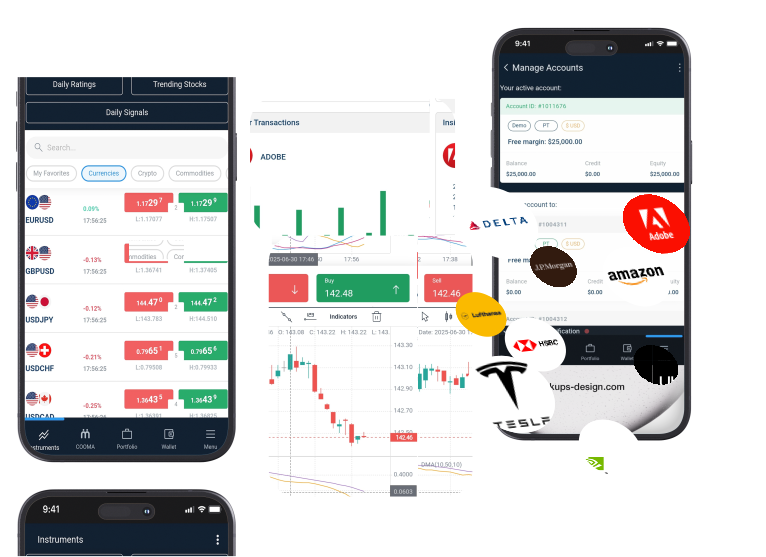
The platform aims to provide a simple, secure, and professional trading experience through platforms such as WebTrader and Mobile App, supported by educational tools like webinars, an academy, demo accounts, and a copy-trading feature.
Licenses and Legal Entity
The platform is owned by Afaq FX Markets (Comoros) LTD, registered in the Comoros.
It is licensed by the MWALI International Services Authority under license number BFX2025079, adding a layer of transparency and reliability for investors.
Key Services
- Trading in forex, stocks, commodities, and indices.
- Islamic accounts are compliant with Sharia.
- Demo account with $25,000 virtual funds for training.
- Advanced analysis tools, live customer support, and competitive trading fees (low spreads).
- Secure deposit and withdrawal procedures.
Account Types
- Basic – Minimum deposit up to $4,999.
- Advanced – From $5,000 to $19,999.
- Premium – $20,000 and above with advanced features.
- Sharia Account – Sharia-compliant, swap-free, with Sharia fees applied after the 4th day.
- Demo – Realistic trading experience with no financial risk.
In Conclusion
Dow Jones Trading remains a cornerstone of global investing, attracting traders seeking both short-term opportunities and long-term wealth accumulation. By understanding the structure, calculation, and market dynamics of the Dow Jones Index, investors can make informed decisions and navigate market volatility with confidence.
Platforms like Afaq empower traders with professional tools, real-time analytics, and expert support, enabling them to approach Dow Jones trading strategically rather than emotionally. Whether analyzing Dow Jones Trading Volume Charts, studying economic indicators, or refining your Dow Jones Trading Strategy, success in this market ultimately comes down to preparation, discipline, and adaptability.
FAQs
How do you trade Dow Jones?
You can trade the Dow Jones via CFDs, futures, or ETFs through platforms like Afaq, which provide real-time data and technical tools.
What is Dow in trading?
Dow refers to the Dow Jones Industrial Average — an index that tracks 30 large-cap U.S. companies, serving as a major indicator of economic performance.
Can I buy shares of Dow Jones?
While you can’t buy the index directly, you can invest in ETFs or funds that replicate its performance or trade CFDs representing its movement.
Is the Dow Jones the S&P 500?
No. The Dow Jones consists of 30 major companies, while the S&P 500 includes 500. Both represent key segments of the U.S. economy but differ in structure and weighting methods.