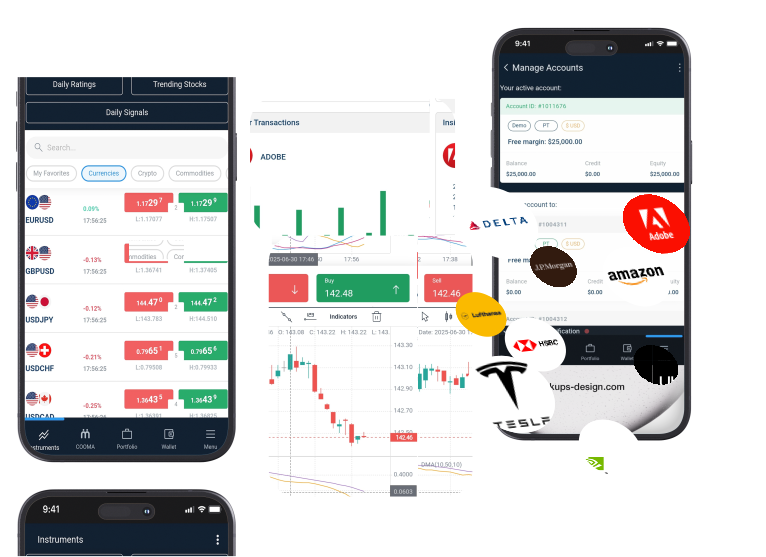
What Is Directional Trading and How Do Traders Use It?
Understanding how markets move is essential for building a consistent trading approach. One of the most effective methods is directional trading, which focuses on identifying and following the overall trend of the market. By aligning trades with price direction, traders can reduce noise and improve decision-making.
This approach works across both rising and falling markets, making it flexible and widely applicable. Mastering this concept helps traders enhance accuracy and manage risk more efficiently.
What Is Directional Trading?
Directional trading is a straightforward yet powerful approach in financial markets where traders take positions based on the anticipated movement of an asset’s price. Unlike strategies that profit from volatility regardless of direction, directional trading focuses on capitalizing when prices move in a specific direction — either upward (bullish) or downward (bearish). This method is favored by traders who believe in the efficiency of trends and aim to profit from sustained price movements rather than short-term reversals.
The beauty of directional trading lies in its adaptability across various financial instruments, including stocks, forex, commodities, and cryptocurrencies.
Whether you are trading on Afaq Trade or another platform, the principles remain consistent: align your trades with the market’s dominant trend and let the momentum work in your favor. However, it is crucial to recognize that this strategy is not foolproof market conditions can shift rapidly, and without proper discipline, even the most promising trends can reverse.
Importance in Financial Markets
Directional trading is a fundamental approach that helps traders navigate financial markets with clarity and purpose. Instead of reacting to every price movement, it focuses on identifying and following the main market trend. This structured method reduces confusion, improves decision-making, and allows traders to align their strategies with overall market behavior. By understanding direction, traders can better manage risk and take advantage of consistent opportunities.
- Provides clarity by focusing on the main market trend (uptrend, downtrend, or sideways).
- Reduces overcomplication by limiting reliance on excessive indicators.
- Aligns with natural market behavior driven by supply, demand, and sentiment.
- Creates opportunities in both bullish (growth) and bearish (decline) conditions.
- Helps improve liquidity and contributes to price discovery by expressing directional views.
How Markets Influence Directional Trading?
Different market environments impact this strategy in distinct ways:
- Trending Markets: Ideal for directional traders, as clear trends provide high-probability trading opportunities.
- Range-bound Markets: Less favorable, as prices oscillate without a dominant direction, making it harder to predict movements.
- Volatile Markets: Can present opportunities but also increase risk, requiring stricter risk management.
- Breakout Markets: Often signal the start of a new trend, offering lucrative entry points for directional traders.
How Directional Trading Works?
To execute directional trading effectively, traders must follow a structured process that begins with market analysis and ends with trade execution and risk management. The workflow breaks down into three critical stages:
- Step 1 Market Analysis: Before entering any trade, directional traders conduct thorough analysis to determine the market’s direction. This involves studying price charts, identifying support and resistance levels, and assessing technical indicators. For example, a trader might observe that a stock has been consistently breaking above a key resistance level, signaling a potential uptrend. Traders using Afaq Trade have access to charting tools that make this analysis more efficient.
- Step 2 Strategy Selection: Once the market direction is identified, traders choose a strategy that aligns with their analysis. Common approaches include trend following (riding the momentum of an established trend), breakout trading (entering when the price breaks through a significant level), and momentum trading (capitalizing on assets gaining or losing speed rapidly).
- Step 3 Trade Execution and Management: After selecting a strategy, traders execute their positions with precise entry and exit points. Effective directional trading is not just about entering trades it is about managing them through stop-loss orders, predetermined profit targets, and position adjustments as the market evolves.
Identifying Market Direction
The ability to accurately identify market direction is the cornerstone of successful directional trading. Here are the key methods used:
- Trend Lines: Trend lines are one of the simplest yet most effective tools. By drawing a line along the highest points in an uptrend or the lowest points in a downtrend, traders can visualize the overall price direction. When price consistently respects these lines, it confirms the trend’s strength.
- Moving Averages: Moving averages smooth out price data to identify the trend over a specific period. A 50-day moving average sloping upward indicates a bullish trend, while a downward slope suggests a bearish trend. Traders often use multiple moving averages (e.g., 20-day and 50-day) to confirm the trend’s direction.
- Price Action Patterns: Candlestick patterns and chart formations — such as head and shoulders or double tops — provide visual cues about market direction. A bullish engulfing pattern, for instance, often signals the end of a downtrend and the beginning of an uptrend.
- Volume Analysis: Volume can reinforce the direction of a trend. Increasing volume during an uptrend confirms strength, while decreasing volume may signal weakening momentum. High volume during a downtrend indicates strong selling pressure.
Bullish vs. Bearish Strategies
Directional trading encompasses two primary strategies — bullish and bearish — each serving a distinct purpose.
| Aspect | Bullish Strategies | Bearish Strategies |
| Market Direction | Expecting prices to rise | Expecting prices to fall |
| Core Approach | Buying assets (long positions) | Selling borrowed assets (short selling) |
| Options Strategy | Buying call options | Buying put options |
| ETFs Used | Leveraged ETFs for amplified gains | Inverse ETFs that profit from declines |
| Example Entry | Enter long on strong upward momentum | Short-sell when the price breaks key support |
| Indicator Confirmation | RSI to confirm bullish momentum and avoid overbought entries | MACD to confirm downward trend |
Key Principles of Directional Trading
Successful directional trading is built on a set of fundamental principles that separate profitable traders from those who struggle.
- Trend Analysis: Trends are your greatest ally in directional trading. The longer and stronger the trend, the higher the probability of continued movement in that direction. Traders should avoid fighting the trend — instead, they should align their positions with the dominant direction and look for opportunities to enter based on trend confirmation signals.
- Market Timing: Timing is everything. Entering a trade too early can result in losses if the trend has not fully developed, while entering too late may miss significant gains. Traders must master the art of patience, waiting for high-probability setups before committing capital.
- Risk vs. Reward: Directional trading requires a disciplined approach to risk management. Traders should always assess the potential reward against the risk of the trade. A common rule of thumb is to aim for at least a 2:1 or 3:1 reward-to-risk ratio — meaning for every dollar risked, the potential profit should be at least two to three dollars.
- Leverage and Position Sizing: While leverage can amplify profits, it also magnifies losses. Traders should never risk more than 1–2% of their total trading capital on a single trade, use leverage that aligns with their experience level, and adjust position sizes based on market conditions — reducing size in high-volatility environments where trends can reverse quickly.
- Trade Confirmation: Not every signal is reliable. Traders should wait for confirmation before entering — from a price action breakout, a volume spike, alignment of multiple indicators (RSI, MACD, moving averages), or a relevant news catalyst that supports the anticipated direction.
Types of Directional Trading Strategies
Understanding the types of directional trading strategies is essential for aligning your approach with different market conditions. By choosing the right strategy based on market direction, traders can improve decision-making and increase their chances of consistent profitability.
Trend Following
Trend following is one of the most popular directional trading strategies, favored for its simplicity and effectiveness in trending markets. The core idea is to identify an established trend and ride it until signs of reversal appear.
How to execute it:
- Use higher-timeframe charts (daily or weekly) to confirm the overall direction. If the 200-day moving average slopes upward, the trend is bullish.
- Wait for pullbacks to the 20-day or 50-day moving average — these often act as support in an uptrend — before entering long.
- Place stop-loss orders below recent swing lows or below the moving average.
- Exit when the trend weakens, such as when the price closes below the moving average or the ADX drops below 20.
Example: A stock is in an uptrend confirmed by price trading above the 200-day moving average. Price pulls back to the 50-day moving average with increasing volume. Entry at the pullback, stop-loss below the recent swing low, take-profit at a 2:1 reward-to-risk target.
Breakout Trading
Breakout trading capitalizes on price movements that break through key levels of support or resistance. Once price breaks out of a consolidation phase, it tends to continue in the breakout direction due to increased momentum.
How to execute it:
- Draw horizontal lines at significant support and resistance levels based on previous swing highs and lows.
- Wait for a close outside the consolidation range with increased volume to confirm the breakout — avoid false breakouts.
- Place stop-loss orders just beyond the breakout level (e.g., if resistance is at $100 and price breaks to $101, stop at $99.50).
- Use a trailing stop or a fixed 1:2 to 1:3 reward-to-risk profit target based on the width of the consolidation range.
Example: Gold consolidates between $1,800 and $1,850. Price closes above $1,850 with volume at 2x the average. Entry just above breakout, stop-loss at $1,845, take-profit at $1,900.
Momentum Trading
Momentum trading focuses on capturing short-term price movements by identifying assets gaining or losing speed rapidly. It thrives in liquid markets like forex, stocks, and cryptocurrencies, where price swings can be dramatic. Traders on Afaq Trade frequently apply momentum strategies during high-impact news events or earnings releases.
How to execute it:
- Identify assets with strong price acceleration — stocks with high relative strength or forex pairs making rapid moves.
- Confirm with indicators: RSI above 70 for bullish momentum, below 30 for bearish momentum, or a MACD bullish crossover.
- Place stop-loss orders just beyond recent swing highs or lows.
- Exit when momentum weakens — RSI diverges from price or the MACD histogram flattens.
Example: Bitcoin surges 10% in one day with RSI at 80. A long position is entered after a MACD bullish crossover is confirmed. Stop-loss below the recent swing low, take-profit at a 1:2 reward-to-risk level.
FAQs
Which indicators are most useful for Directional Trading?
The most effective indicators for directional trading are those that confirm trend direction and momentum rather than generating signals in isolation. Moving averages — particularly the 50-day and 200-day — are the foundation, providing a clear visual of the prevailing trend. The RSI is invaluable for identifying overbought and oversold conditions that signal potential entry or exit points within a trend.
Is Directional Trading suitable for beginners?
Directional trading is widely considered one of the most beginner-friendly trading approaches because its core concept is simple: determine whether the market is going up or down and trade accordingly. Unlike more complex strategies that require understanding of options pricing, volatility surfaces, or multi-leg structures, directional trading can be learned progressively — starting with trend identification on daily charts and gradually incorporating risk management tools like stop-loss orders and position sizing.
How does Directional Trading differ from non-directional strategies?
Directional trading requires the trader to take a clear view on the future movement of an asset's price — either up or down — and profits only when that prediction is correct. Non-directional strategies, by contrast, are designed to profit regardless of which way the market moves, typically by exploiting volatility, time decay, or price relationships between related assets.