How to Use ChatGPT for Trading Smarter?
ChatGPT can support traders by organizing research, explaining market concepts, analyzing uploaded data, reviewing strategy rules, and checking risk calculations. Its value comes from improving structure, clarity, and verification—not from predicting prices or generating guaranteed signals. Used responsibly, it can help transform vague trading ideas into testable processes, summarize official documents, inspect historical data, and audit trading journals. This guide explains how to use ChatGPT for trading responsibly within an AFAQ workflow, how to protect sensitive information, verify every output, test ideas in a demo account, and avoid common risks such as hallucinations, outdated data, confirmation bias, and false precision.
What Is ChatGPT in the Context of Trading?
ChatGPT is a conversational AI assistant that can understand instructions, process text, analyze supplied information, and generate structured responses. For traders, its main value lies in supporting research and analysis rather than replacing market data, professional advice, or human decision-making.
It can explain financial terminology, summarize company reports and economic announcements, structure a trading plan, analyze historical data from a spreadsheet, review strategy logic, check risk-management scenarios, organize a trading journal, and identify assumptions that require further verification.
ChatGPT is different from a traditional trading bot. A programmed trading bot may follow predefined rules and connect directly to a platform to execute orders. A standard ChatGPT conversation does not automatically open, manage, or close trades. It helps the trader define, question, and test ideas that may later be implemented through suitable tools.
What ChatGPT Can and Cannot Do for Traders?
The following comparison clarifies where ChatGPT may add value and where traders should not rely on it.
| ChatGPT can help with | ChatGPT should not be relied on to |
| Explain indicators and market concepts | Guarantee profitable trades |
| Summarize supplied reports and announcements | Predict future prices accurately |
| Analyze uploaded spreadsheets | Replace live market data |
| Review strategy rules | Determine personal risk tolerance |
| Help write backtesting code | Manage a portfolio without oversight |
| Structure risk calculations | Provide regulated financial advice |
| Interpret uploaded chart screenshots | Execute orders through AFAQ automatically |
| Compare different scenarios | Confirm Sharia compliance independently |
The quality of an AI-generated response depends heavily on the source, freshness, completeness, and accuracy of the information supplied. A confident response is not necessarily a correct response, and a detailed calculation may still be unreliable when essential variables are missing.
How to Use ChatGPT for Trading?
A disciplined workflow reduces ambiguity and makes the output easier to verify. Each step should define what information is being used, what ChatGPT is expected to do, and how the result will be checked before it influences a trading process.
1. Define the Exact Question
Avoid broad questions such as:
What will gold do next?
This request does not define the data source, timeframe, method, or limitations. A more useful prompt would be:
Based only on the attached daily gold-price data from January 1 to June 30, calculate the current trend, 20-day and 50-day moving averages, recent volatility, and maximum drawdown. Do not predict future prices.
The second request produces a task with defined inputs and measurable outputs. It can be repeated, checked, and compared with another calculation.
2. Gather Reliable Data
Collect the relevant information from a reliable source before requesting analysis. Depending on the task, this may include historical price data, official company financial statements, central-bank announcements, an economic-calendar release, a chart screenshot, an exported trading journal, or backtesting results.
Record the exact source and the period covered. Do not ask ChatGPT to recall precise market figures from memory when the original document or dataset is available.
4. State the Source, Date, and Timeframe
Every market-related prompt should identify the asset or instrument, market, timeframe, data source, last available date, required output format, and the action ChatGPT should take when information is missing.
This reduces the risk of mixing historical information with current conditions or analyzing the wrong instrument, session, contract, or currency.
5. Request a Structured Output
Ask for a table, calculation, checklist, audit, or scenario analysis rather than an unstructured opinion.
For example:
Return the results in a table with the following columns: metric, value, interpretation, limitation, and verification required.
A defined structure makes missing information and unsupported conclusions easier to detect.
6. Verify the Response
Review all prices, dates, calculations, company names, ticker symbols, economic figures, regulatory statements, indicator settings, assumptions, and claimed sources.
Where possible, ask ChatGPT to show the formula and calculation steps rather than providing only the final conclusion. Then compare the output with the original file, official announcement, and AFAQ instrument specifications.
7. Test Before Applying
A trading idea should pass through a structured testing process:
- Convert the idea into objective rules.
- Test the rules on historical data.
- Review performance across different market conditions.
- Test the process in a demo environment.
- Evaluate risk, costs, liquidity, and execution limitations.
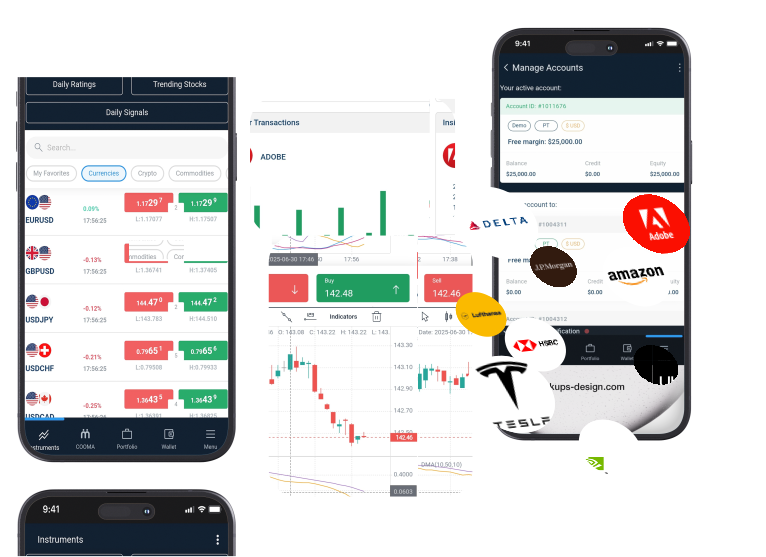
AFAQ provides a demo environment for practicing with virtual funds across markets such as forex, stocks, commodities, indices, and ETFs. A demo account can help test the mechanics of a process, but it cannot fully reproduce live-market liquidity, slippage, emotional pressure, or the impact of losing real capital.
Five Practical Ways to Use ChatGPT for Trading
ChatGPT is most useful when the task is narrow, the data is supplied directly, and the output can be verified. The following applications focus on research, process improvement, calculation, and testing rather than predictions.
1. Summarizing Fundamental Information
ChatGPT can help traders work through long documents such as earnings reports, investor presentations, central-bank statements, economic reports, company announcements, and industry research.
The original source should be uploaded or quoted directly. The prompt should restrict the analysis to that source and require page or section references for material figures.
Example Prompt
Using only the attached quarterly report for [company name], summarize:
- Revenue growth.
- Operating-margin changes.
- Debt and liquidity.
- Management guidance.
- The three most material risks.
Cite the page number for every figure. Clearly label information that is unavailable, and do not estimate missing values.
Verification Step
Compare every financial figure, period, currency, and management statement with the original company report before using the summary.
2. Analyzing Historical Data and Charts
ChatGPT can analyze uploaded spreadsheets and interpret chart screenshots when the visible information is sufficiently clear. It may help calculate indicators, visualize trends, inspect drawdowns, and identify features within the supplied data.
It should not be asked to predict the next price movement solely because a chart pattern appears to be visible.
Example Prompt
Analyze the attached EUR/USD daily-price CSV covering January 1 to June 30.
Calculate:
- The 20-day moving average.
- The 50-day moving average.
- The 14-period RSI.
- Average daily range.
- Maximum drawdown.
Show the calculation method, identify missing rows, and do not provide a buy or sell recommendation.
Verification Step
Check that the correct price column was used, the dates were parsed accurately, the rows were sorted chronologically, the indicator settings match those on AFAQ, and missing sessions did not distort the calculation.
3. Turning a Trading Idea into Testable Rules
Trading ideas are often described using subjective phrases such as:
Buy when momentum looks strong.
This statement cannot be tested consistently because different traders may define “strong momentum” differently.
ChatGPT can help convert the idea into measurable entry, exit, risk, and cancellation conditions.
Example Prompt
Convert the following strategy idea into objective backtesting rules:
“Trade bullish momentum when price is above the medium-term trend.”
Define:
- Instrument and timeframe.
- Entry conditions.
- Exit conditions.
- Stop-loss logic.
- Position-sizing rule.
- Maximum simultaneous positions.
- Transaction-cost assumptions.
- Conditions that cancel a trade.
Do not optimize the parameters. List every assumption requiring human approval.
Verification Step
Confirm that two different traders could follow the rules without interpreting words such as “strong,” “near,” “significant,” or “good.” Any remaining subjective condition should be rewritten or defined numerically.
4. Reviewing Risk-Management Scenarios
ChatGPT can help explain or check position-sizing calculations when the user provides the account balance, planned risk, entry price, invalidation or stop level, contract size, account currency, and relevant conversion rate.
It cannot determine the correct risk level for an individual, because this depends on personal finances, experience, objectives, obligations, and the ability to absorb losses.
Example Prompt
This is an educational calculation, not a trade recommendation.
Account balance: [amount]
Maximum planned risk: [percentage]
Entry price: [price]
Stop-loss price: [price]
Instrument contract size: [value]
Account currency: [currency]
Calculate the monetary risk and theoretical position size. Show the formula and identify missing variables, including currency conversion, spread, commission, slippage, and minimum lot-size requirements.
Verification Step
Confirm the result using AFAQ’s current contract specifications, minimum trade size, value per movement, and margin conditions. Reject the calculation when a required variable is unavailable.
5. Reviewing a Trading Journal
A trading journal can reveal repeated behavioural, process, and execution problems that may not be obvious when each trade is reviewed independently.
After removing personal and account-identifying information, ChatGPT can classify strategy type, entry reason, planned risk, actual risk, rule adherence, time of day, emotional state, result in risk units, and recurring execution mistakes.
Example Prompt
Analyze the attached anonymized trading journal.
Do not evaluate performance based only on total profit.
Identify:
- Rule-adherence rate.
- Average result in R-multiples.
- Performance by strategy.
- Performance by session.
- Average planned risk versus actual risk.
- The three most common execution errors.
Separate statistical observations from hypotheses. Do not infer causes that are unsupported by the data.
Verification Step
Ensure that losing trades that followed the plan are not automatically classified as mistakes. Profitable trades that violated the rules should not automatically be described as good execution.
Six Practical ChatGPT Prompts for Traders
The following prompts are reusable templates. Replace every placeholder and provide the relevant source material before using them.
Prompt 1: Economic Announcement Summary
Using only the attached announcement issued by [official institution] on [date], summarize the policy decision, changes from the previous announcement, and the risks mentioned by the institution. Cite the relevant paragraph for every conclusion and do not predict market direction.
Prompt 2: Company Comparison
Compare [Company A] and [Company B] using only their attached financial statements covering the same reporting period. Compare revenue growth, operating margin, net debt, free cash flow, and management guidance. Flag differences in accounting periods or currencies.
Prompt 3: Backtest Review
Review these backtest results: [metrics]. Identify possible overfitting, excessive drawdown, unrealistic transaction costs, insufficient sample size, and dependence on a small number of trades. Do not describe the strategy as profitable or reliable without out-of-sample evidence.
Prompt 4: Scenario Analysis
Create three scenarios for [asset or market]: positive, neutral, and negative. For each scenario, list the required conditions, invalidation evidence, variables to monitor, and information sources. Do not assign probabilities unless data is supplied.
Prompt 5: Chart Review
Analyze the attached chart screenshot. First list the instrument, timeframe, visible indicators, and date range that can be read from the image. If any item is unclear, state that explicitly. Describe the structure without predicting the next move.
Prompt 6: News Verification Checklist
Review the following market claim: [claim]. Create a verification checklist identifying the primary institution, publication date, original document, relevant market session, and data that would confirm or contradict the claim.
Considerations for Traders in the MENA Region
Regional trading analysis requires precise market, regulatory, currency, and session information. Broad references to the UAE, Saudi Arabia, or the MENA region can lead to inaccurate conclusions when the relevant exchange, instrument, regulator, and legal entity have not been specified.
Define the Market Precisely
A request such as “Analyze the UAE market” is too broad. A useful prompt should define the exchange or index, instrument, currency, local timezone, date range, trading session, data source, price-adjustment method, and whether dividends are included.
For example:
Using only the attached daily data for [regional index] from [source], covering [dates] in [currency], calculate monthly returns and drawdowns. Do not use information outside the supplied file.
Do Not Use ChatGPT as a Regulatory Authority?
Financial regulations differ according to country, legal entity, instrument, regulated activity, and client classification. They can also change over time.
ChatGPT may summarize a regulatory document supplied by the user, but the original document and the relevant authority should remain the source of truth.
Before relying on a regulatory reference, confirm the correct jurisdiction, authorised activity, publication date, affected person or institution, and whether the information applies to AFAQ or the instrument being discussed.
A regulator mentioned for educational purposes is not automatically the regulator or licensing authority of AFAQ.
Use ChatGPT to Understand Sharia Screening, Not to Issue a Ruling
ChatGPT can explain general concepts commonly discussed in Islamic finance, including interest, overnight financing, excessive uncertainty, ownership and settlement, business-activity screening, financial-ratio screening, and differences between scholarly standards.
It should not independently declare that a particular stock, instrument, account, or transaction is halal or haram.
AFAQ publishes information about its Islamic account, but a specific Sharia question should be assessed using the current product terms and an appropriately qualified Sharia or financial specialist.
A safer prompt is:
Explain the general Sharia-screening criteria that may be relevant to this instrument. Do not issue a religious ruling. List the financial data, contract terms, and scholarly interpretation that would need to be reviewed by a qualified specialist.
The Main Risks of Using ChatGPT for Trading
AI can accelerate analysis, but it can also produce convincing errors. The following risks should be considered before using any generated output in a trading process.
Hallucinated Information
ChatGPT may generate names, figures, regulations, sources, or explanations that sound plausible but are inaccurate or invented.
Never rely on a claimed source unless the original document can be opened, checked, and matched to the statement being made.
Outdated or Mismatched Data
Web search and uploaded-data analysis may improve access to recent information, but they do not guarantee that the latest market price was used, the correct instrument was identified, the source was primary, the publication time matched the market session, or the data was free from delays and adjustments.
Always verify the instrument, timestamp, market session, and source before using the result.
Confirmation Bias
A leading prompt may push the model toward the answer the trader already wants.
Instead of asking:
Explain why this stock is a good buy.
Use:
Present the strongest evidence supporting and contradicting this thesis. Identify the evidence that would invalidate it.
False Precision
A model may calculate a precise target, probability, or position size when essential information is unavailable.
Prompts should explicitly instruct ChatGPT to stop and identify missing variables rather than estimating them.
Strategy Overfitting
ChatGPT can generate many strategy variations quickly. Testing enough combinations may eventually produce an impressive historical result by chance.
A strategy should be reviewed for out-of-sample performance, walk-forward testing, transaction costs, slippage, parameter sensitivity, performance across market regimes, sufficient trade count, maximum drawdown, and dependence on a small number of outlier trades.
FAQs
Can ChatGPT predict market movements accurately?
No. ChatGPT can organize research, calculate metrics, and analyze information supplied by the user, but it cannot reliably predict future prices. Market outcomes depend on new information, liquidity, investor behaviour, execution conditions, and unexpected events. Any analysis should be treated as a testable interpretation rather than a guaranteed forecast or trading signal.
Does ChatGPT provide real-time market data?
Some ChatGPT experiences may retrieve recent public information, but this should not be treated as a guaranteed live institutional feed. Prices can be delayed, mismatched, or taken from a different instrument or session. Current quotes, spreads, trading conditions, and contract details should always be confirmed directly through AFAQ and relevant primary sources.
Can ChatGPT analyze a trading chart?
ChatGPT can inspect an uploaded chart or screenshot and describe visible trends, labels, indicators, and price structure. Accuracy depends on the image quality, timeframe, date range, symbol, and visible settings. Any extracted price, indicator value, or pattern should be checked on AFAQ before being used in analysis or risk calculations.
Can ChatGPT execute trades through AFAQ?
No. A normal ChatGPT conversation does not automatically connect to an AFAQ account or place, modify, and close trades. It may help organize research or review rules, but execution remains separate. Never provide an AI chatbot with your AFAQ password, verification code, payment details, recovery information, or remote access to your device.
Should an AI-assisted strategy be tested in a demo account?
Yes. A demo account provides a safer environment for checking whether the rules, calculations, and execution process work as intended without risking deposited capital. However, demo results do not guarantee live performance because real trading introduces slippage, liquidity changes, emotional pressure, costs, and execution differences that may materially affect the outcome.